Turning Japanese: Future Beauty at the Barbican


The Barbican's Future Beauty is an appropriately stylish and well put together exhibition, surveying contemporary Japanese fashion from the 1980s to the present day, focusing on the avant-garde work of ground-breaking designers like Yohji Yamamoto, Rei Kawakubo of Comme des Garcons and Issey Miyake. These are designers who brought about a revolution in the fashion landscape, mounting a challenge to accepted Western notions of feminity and beauty, and changing irrevocably the way we dress.

Here, their work is carefully presented in a space divided by translucent drapes that hang from floor to ceiling. The gallery makes the perfect backdrop for these garments, with their origami-like folds and unfinished hems, themselves as much sculptural art objects as they are items of clothing, as Naoya's Hatekeyama's extraordinary photographs of Rei Kawakubo's flat garments makes clear. Issey Miyake's A-POC is far more sci-fi art installation than it is conventional ready-to-wear.

It's helpful then, that this exhibition is organised along thematic, rather than chronological lines, allowing us to follow the thread of an idea or style as it evolves through different interpretations. Exploring concepts such as wabi-sabi (the beauty of imperfection) and ma (the notion of spaces between objects) this curatorial approach allows us to understand some of the complex and challenging thinking that lies behind these apparently simple, minimal and often startlingly beautiful constructions, as well as the furore they created when they first appeared on the catwalk.

The exhibition is supported by a wealth of fascinating film and video content, including catwalk shows and documentaries, most notably Wim Wenders' classic documentary on Yamamoto, Notebook of Cities and Clothes, which will leave you forever in thrall to the power of the black polo neck. A perfect introduction to Japanese fashion in advance of Yamamoto's upcoming solo exhibition at the V&A it may well be, but Future Beauty is more than that, standing up in its own right as an ambitious and inspiring exhibition, not merely for those who love fashion, but for anyone with an interest in contemporary visual culture.

Future Beauty is at the Barbican Art Gallery until 6 February 2011.

[Images from Future Beauty: 30 Years of Japanese Fashion, 15 October 2010 – 6 February 2011 at Barbican Art Gallery, London. Photocredit: Lyndon Douglas]

Awards Time: thoughts on the Northern Art Prize and South Bank Sky Arts Awards


Last week, this year's Northern Art Prize (which I wrote about here last year) was awarded to Haroon Mirza. This annual prize goes to a professional artist of any age, working in any medium living in the north of England. Although perhaps the best known artist on the shortlist, Mirza was maybe also something of an unexpected winner, having, as you might say, 'a foot in both camps' both geographically (working in Sheffield and in London) and as an artist working predominantly with sound and music. Sound art is clearly experiencing something of a boom at the moment, with Susan Philipzs's beautiful installation Lowlands triumphing in the Turner Prize; yet interestingly, Mirza himself is clearly keen to avoid simple pigeonholing.  Rather than being described as either a 'sound artist' or a 'visual artist', he places himself somewhere in between, perhaps recognising that the spaces between are often the most interesting places to be.

This week brings us to the announcement of the South Bank Sky Arts Awards, which have a much wider remit: to recognise the best of British talent right across the arts, from classical music to comedy, opera to TV drama. There are some great names up for these awards, including a pleasingly unexpected all-female shortlist in the visual arts category, in which heavyweights Tacita Dean and Angela de la Cruz appear alongside newcomer Josephine King, who held her first exhibition of powerful, technicolour portraits of her battle with bi-polar disorder only last September. It's fantastic to see King on this list, as all too often it's the same old big name artists who attract all the glossy accolades. But perhaps, as with the Turner and the NAP, the visual arts world is moving away from the days where one particular style or trend dominated, and towards a future in which we can recognise and celebrate the rich diversity and variety of contemporary visual art.

With this in mind, if I were able to pick up my contemporary art magic wand this week (and goodness knows what that would look like!) I'd be bestowing a South Bank Sky Arts Award on some of our slightly less well-known contemporary visual artists, such as Charles Avery or Olivia Plender, Rachel Goodyear or Ryan Gander. And in the meantime, although Dean and de la Cruz are certainly deserving, I'll be crossing my fingers on Tuesday night for Josephine King.

[Image: Haroon Mirza, Birds of Pray 2010; mixed media, via Northern Art Prize]

Matthew Bourne's Cinderella


 Every year on my birthday, I try to go and see a ballet. It's the perfect thing to do on a cold January day, bringing a little sparkle and brightness to even the darkest winter evening. This year's birthday celebration (I've just turned a hale and hearty 28, in case you're wondering...) was Matthew Bourne's Cinderella at Sadler's Wells.

Bourne has become synonymous with doing things differently, and his much hyped take on Cinderella is no exception. Here, he takes the lead from Prokofiev's romantic, yet darkly sombre score, composed in the 1940s, and transports the action to London in the Blitz. There's a kind of desperate glitter and giddy gaiety to this fairytale set against a shadowy, desolate landscape of shattered buildings and bomb blasts. Cinderella is a mousy young girl, bullied by her stepbrothers and sisters, but especially by her stepmother: a Cruella-style vamp who struts the stage in a fur coat, downing gins. Her fairy-godmother (or indeed godfather in this case) is a glittering, silver-suited, platinum haired angel who arrives on a white motorbike, and orchestrates a romantic meeting with a wounded airman. But the lovers are separated in London's dark streets, and struggle to find each other as they dance through a dark underworld of violence and wailing air raid sirens, in which time turns upside down and the lines between reality and hallucination become blurred.

Paying homage to everything from the tragic romance of Brief Encounter to the surrealism of the Powell and Pressburger classics of the 1940s (perhaps especially An Affair to Remember); Busby Berkley musicals to Kenneth MacMillan's Romeo and Juliet, this is a delightfully clever, as well as hugely enjoyable, production. I was inspired by the beautiful production design, especially the 1940s costumes. And in spite of the dark and disturbing threads woven through Bourne's world of dancing air-raid wardens and raiding sirens, I loved the final happy ending: a tender, touching, jitterbug-joyous finale to the perfect birthday ballet.

Philippe Parenno at The Serpentine


First exhibition for 2011 - Philippe Parenno's solo show at the Serpentine. The white space of the gallery interior is transformed as we move through the space, and shutters suddenly, theatrically close out the bright January sunlight. A cycle of short films play out on a series of screens that seem to appear and disappear: June 8, 1968 is a crisp technicolour recreation of the train journey that transported the body of assassinated senator Robert Kennedy from New York to Washington D.C.; whilst Invisibleboy tells the story of a Chinese immigrant boy who sees imaginary monsters, created by scratching into the film stock itself. As the film concludes, the shutters rise again: the glass is now covered in a ghostly fog, and snow drifts softly against the window, in spite of the blue skies.  In another room, a grainy hand-held film shows a group of French children waving placards, and chanting: No more reality!' An apt slogan for this atmospheric and faintly magical exhibition exploring the relationship between the fictive and the real.


[All images via Serpentine]

Surround Me


On a chilly New Year's Day, we cycled through the silent streets of the City of London to discover Surround Me: A Song Cycle for the City of London. This series of site-specific sound installations is the Turner Prize-winning artist Susan Philipsz's first commission for London, and took us from the banks of the River Thames, down secret medieval alleyways, and through empty city squares.

Some of the locations proved tricky to find, and we later discovered that unfortunately not all the sites were still working. But on the grey first day of the new year, we enjoyed the experience of stumbling upon the melancholy, magical sound of Elizabethan madrigals, resonating through empty streets, blending with the sounds of traffic, birdsong and church bells.

This commission for Artangel takes its inspiration from the City's vocal tradition and the sounds of the past: there is a haunting quality about these melodies, which make oblique or explicit references to loss, disappearance and absence, linking the passage of time to the flowing tide of the river. All at once, History seems acutely present in what Peter Ackroyd  calls 'the teeming silence of the city' or as Iain Sinclair puts it in his video about Surround Me, for Tate Shorts, below, 'time in the city is plural'.


Susan Philipsz also speaks about Surround Me in an Artangel Podcast, Memory. Click here to listen.

[Image via Artangel]

Exhibitions of the Year 2010

Somehow, I couldn't quite seem to restrict myself to a mere 'top five' exhibitions of the year this time round, so here's my (somewhat unconventional) 'top six' favourite exhibitions of 2010:

6. Exhibition #3 at the Museum of Everything.

Whilst the latest offering may not have been quite as challenging as their first exhibition, which I saw in 2009, visting the Museum of Everything is always a delightful experience. Co-curated by Sir Peter Blake, this enjoyable exhibition was a glorious riot through English eccentricity, from Punch and Judy puppets to seaside souveniers to taxidermied kittens: a friendly breath of fresh air in comparison to the slick minimalism of so many galleries and arts venues.


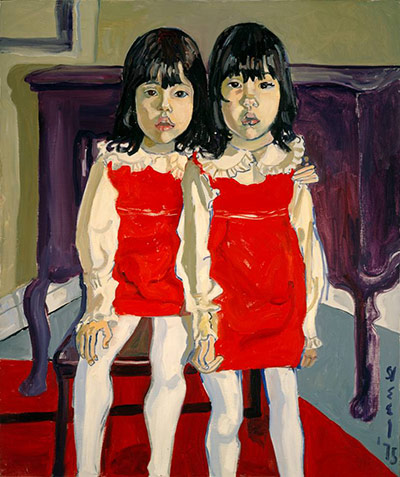
5. Alice Neel: Painted Truths at the Whitechapel

I wasn't very familiar with Alice Neel's work until I went to see this impressive and very comprehensive exhibition at the Whitechapel Art Gallery earlier this year. Focusing predominantly on Neel's portraiture, this sensitive exhibition brought together a blunt, unflinching and very powerful body of work.


4. Touched: Liverpool Biennial 2010

OK, so maybe I'm cheating slightly with this one, since Touched is really a whole programme of exhibitions rather than just one. Though no single artwork or venue especially stood out for me, the power of this year's Liverpool Biennial was its overall energy and dynamism, as well as the sheer range and diversity of work to discover in unexpected places all over the city. My highlights were Laura Belém's The Temple of a Thousand Bells (pictured), Tehching Hsieh at FACT,  Nicholas Hlobo at Bluecoat, and Ryan Trecartin's frankly bizarre Trill-Ology.


3. Chris Ofili at Tate Britain

I wasn't totally sure whether I really liked Chris Ofili's work until I saw this mesmerising retrospective exhibition at Tate Britain early in 2010. Powerful and compelling, this exuberant, joyous explosion of vibrant colour and texture was also incredibly well thought-out: a great example of what Tate do best.


From Here To Ear - Céleste Boursier-Mougenot

2. Céleste Boursier-Mougenot at the Barbican

For sheer enjoyment, this charming commission for the Barbican's Curve Gallery wins hands down. French artist Celeste Boursier-Mougenot transformed the space into a magical and uplifting soundscape, starring a flock of zebra finches. Frankly, contemporary art doesn't get much better than watching a zebra finch take a bath in a cymbal.


1. Diaghilev and the Golden Age of the Ballet Russes at the V&A

Narrowly squeezing in at the very end of the year, this entralling and highly atmospheric exhibition at the V&A was one of my highlights of the year. Blending visual materials with a whole range of fascinating background information about the choreography, music and design of Diaghilev's groundbreaking productions, this was a beautifully curated exhibition: rich, evocative, and full of bohemian splendour.


Read my top five exhibitions from 2009 

Merry Christmas!


Just a quick post to wish everyone a very Merry Christmas. See you in 2011!

[Image via Tumblr]