Showing posts with label barbican. Show all posts

Cory Arcangel: Beat the Champ


It's been an historic week, so what shall I write about today? The Royal Wedding? The death of Osama Bin Laden? AV? Nope: media art inspired by computer gaming, that's what.

Cory Arcangel is one of the best-known artists working with computer technology, including video games, software and the internet. His digital interventions are pleasingly subversive, playful and often tongue-in-cheek: I love his weirdly hypnotic Super Mario Clouds (2002) in which he transforms Nintendo's classic Super Mario Brothers game by removing all the elements except for endlessly scrolling clouds. Another appealing piece of work is Drei Klavierstüke, op 11 (2009) - a note-by-note, frame-by-frame version of Klavierstüke op 11 (1909) by Arnold Schoenberg, recreated entirely using Youtube videos of cats playing pianos.

I was intrigued, therefore, to pop along to the Barbican's Curve Gallery this week to see the newest installation by Arcangel, Beat the Champ, which brings together a series of 14 bowling video games from consoles from the 1970s to the present day. Projected along the length of the dimly lit gallery, which itself becomes a kind of virtual bowling alley, the consoles have all been programmed by the artist to play continuous - but scoreless - games. The result is an entertaining collage of endless 'gutter balls' and 'no scores', whilst the combined sounds of all the different games create an intriguing cacophany of sound. It's a clever piece: fun, slightly mocking, but also genuinely thoughtful about the roles technology and gaming plays in our lives - in this case, their failures as much as their potential.

Beat the Champ is on show until 22 May 2011. If this sort of thing is up your street, there's also a talk linked to the exhibition taking place next Wednesday at 7.00pm: Ear Candy will be exploring the role of music in video games from the Commodore 64 era to the present day.

Also here's the film with the cats, because... um... well, just because...


[Photocredit: Eliot Wyman]

Turning Japanese: Future Beauty at the Barbican


The Barbican's Future Beauty is an appropriately stylish and well put together exhibition, surveying contemporary Japanese fashion from the 1980s to the present day, focusing on the avant-garde work of ground-breaking designers like Yohji Yamamoto, Rei Kawakubo of Comme des Garcons and Issey Miyake. These are designers who brought about a revolution in the fashion landscape, mounting a challenge to accepted Western notions of feminity and beauty, and changing irrevocably the way we dress.

Here, their work is carefully presented in a space divided by translucent drapes that hang from floor to ceiling. The gallery makes the perfect backdrop for these garments, with their origami-like folds and unfinished hems, themselves as much sculptural art objects as they are items of clothing, as Naoya's Hatekeyama's extraordinary photographs of Rei Kawakubo's flat garments makes clear. Issey Miyake's A-POC is far more sci-fi art installation than it is conventional ready-to-wear.

It's helpful then, that this exhibition is organised along thematic, rather than chronological lines, allowing us to follow the thread of an idea or style as it evolves through different interpretations. Exploring concepts such as wabi-sabi (the beauty of imperfection) and ma (the notion of spaces between objects) this curatorial approach allows us to understand some of the complex and challenging thinking that lies behind these apparently simple, minimal and often startlingly beautiful constructions, as well as the furore they created when they first appeared on the catwalk.

The exhibition is supported by a wealth of fascinating film and video content, including catwalk shows and documentaries, most notably Wim Wenders' classic documentary on Yamamoto, Notebook of Cities and Clothes, which will leave you forever in thrall to the power of the black polo neck. A perfect introduction to Japanese fashion in advance of Yamamoto's upcoming solo exhibition at the V&A it may well be, but Future Beauty is more than that, standing up in its own right as an ambitious and inspiring exhibition, not merely for those who love fashion, but for anyone with an interest in contemporary visual culture.

Future Beauty is at the Barbican Art Gallery until 6 February 2011.

[Images from Future Beauty: 30 Years of Japanese Fashion, 15 October 2010 – 6 February 2011 at Barbican Art Gallery, London. Photocredit: Lyndon Douglas]

John Bock at the Barbican


Although I knew that there was little chance that the new Barbican Curve exhibition was going to be anywhere near as entertaining as Céleste Boursier-Mougenot's fabulous birds, I went along to see the new installation by John Bock: Curve-Vehicle incl. π- Man-(.) this week.

This is the first major UK commission for German artist Bock, who is best-known for his absurd and eccentric interventions that that combine sculpture, film, installation art and performance. The 'Curve-Vehicle' itself is a four and a half metre high structure constructed from a patterned grille of steel in bright primary colours, which to me at least, was vaguely reminiscent of climbing frames in children's playgrounds - although according to the exhibition notes they in fact reference "the colourful fences often seen in the former East Germany", so there you go.

This construction is mounted on a London taxi chassis, and is chaotically and idiosyncratically furnished with a jumble of plastics, fabrics, found and hand-made objects that range from old LPs to a Sylvanian family dolls-house. A series of ovoid chambers each appear intended for a particular purpose - from sleeping to listening to music.

The vehicle is designed to be able to 'dock' with a series of other insect-like pod structures, which Bock refers to as 'parasites' and which dangle from the gallery walls and ceiling. These are kitted out as a noodle bar (furnished with packets of noodles and Chinese lanterns) and clothing and second hand shops. Altogether, these structures form an alternative, experimental urban space, alluding to the work of iconoclastic 1960s architects such as Archigram, who decreed 'the house is an appliance for carrying with you, the city is a machine for plugging into'. More specifically, the work also references the space of the Barbican, itself a work of utopian architecture, and a vision of a more fluid and flexible mode of urban life.

As well as the structures themselves, the gallery also features a film of one of the artist's 'lectures' in which an actor operates the vehicle, and participates in a series of chaotic social and commercial transactions with other actors, who play the role of 'shopkeepers' in the surrounding pods. For Bock, however, it is the objects themselves which are the main actors in these absurd and often comedic performances: 'They become active, contain theories and little stories'. Exactly what kind of stories these madcap structures contain, I have to admit I'm not too sure, but watching and speculating is certainly entertaining.

Curve-Vehicle incl. π- Man-(.) will be showing in the Barbican's Curve gallery until 12 September 2010.

celeste boursier-mougenot: barbican commission

From Here To Ear - Céleste Boursier-Mougenot

I love this new commission for the Barbican's Curve Gallery - a magical sonic art installation created by artist Céleste Boursier-Mougenot.

Entering the gallery through a chain curtain, you first pass through a dark space with a series of video projections and buzzing sounds. So far, so conventional. But then, turning the corner, you find yourself within a very different space, where a flock of rather adorable zebra finches are fluttering between a series of sandy islands furnished with different musical instruments: electric guitars, basses, cymbals and microphone stands.

As the birds go about their activities (taking a bird bath in a cymbal or pecking bits of twig from an electric guitar) and move through the space, they create a random soundscape that blends with the tweeting and chirruping of the birds themselves. Charming, uplifting and seriously cute.


The installation is in the Barbican's Curve Gallery until 23 May 2010.

UPDATE (17.03.10) - one of the birds has laid an egg on a guitar! Read the full story here.

[Image (top) by CarolienC on Flickr via Creative Commons]

outdoor art: wheatfield and the dalston mill

I've recently been to check out The Dalston Mill and Wheatfield – A Confrontation: two new offsite commissions as part of the Barbican Art Gallery’s current exhibition, Radical Nature – Art and Architecture for a Changing Planet 1969-2009.

The Dalston Mill is the brainchild of experimental architectural collective EXYZT, who have transformed a disused railway line and area of wasteland just off Dalston lane into a ‘rural retreat’ in the heart of the city, intended for the use of the local community.

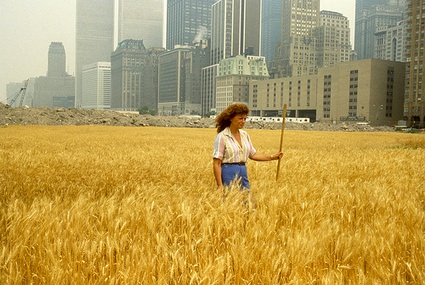
The fully-functioning but temporary 16 metre mill on the site is accompanied by a 20 metre long wheat field, intended as a restaging of environmental artist Agnes Denes’ pioneering 1982 work Wheatfield – a Confrontation (see above). For the original piece, Denes planted and harvested two acres of wheat in Battery Park landfill in New York, situated between the Statue of Liberty and the World Trade Centre. The restaging of this work may be less radical (and is certainly a lot smaller) than the original work, but it’s still thought-provoking to experience this small corner of rural nature in the midst of a hectic urban environment. What’s more, the work raises some interesting issues about land use and ownership, autonomy, community, economy and sustainability at local level: the idea is that the mill will be processing grains from the field when the wheat is ready to be harvested. The resulting flour will then be baked into bread - transforming urban wasteland into a functional community space.
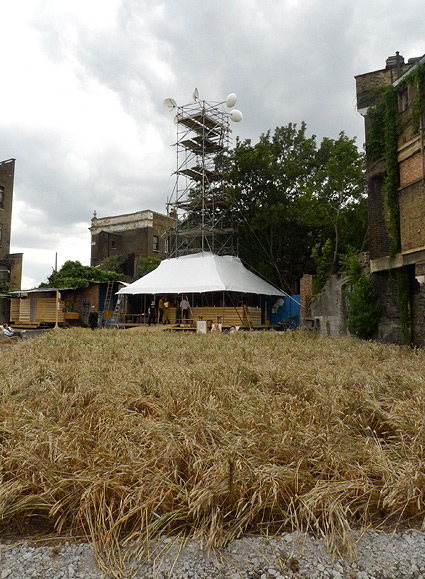

When we arrived at the site, on a reasonably sunny Saturday afternoon, the Mill was already buzzing with activity. People in deckchairs by the wheatfield enjoyed cold beers from the bar; small children pranced on a stage strung with fairy-lights; a cluster of people were gathered for a demonstration of the pedal-powered mill; and we were immediately invited to join in a free bread-making workshop with artisan baker Dan Lepard.

The purpose of the workshop was in fact to bake not loaves of bread, but a unique bread-based currency: The Dalston Slice, a bread coin that is being baked and sold only at the Dalston Mill. The coin can be redeemed for goods or services with local traders and producers who have agreed to be part of this alternative currency experiment, ranging from the Arcola Theatre to the Trendsetters Hair Salon to London Fields Cycles. After spending an enjoyable time making the bread ‘coins’ we were each rewarded with some currency: we chose to take our handmade coins along to the Dalston Superstore to exchange them for a slice of cake apiece.

It's lovely to see this patch of unloved wasteland reinvigorated as a lively community space: throughout the Radical Nature exhibition, it will also be the setting for a whole programme of workshops, talks, performances and events ranging from cake decorating workshops to an in conversation event with the architects to African dancing to lectures on urban psychoanalysis. And as well as a thought-provoking use of disused land, it’s also quite simply a very pleasant place to while away a summer afternoon: a secret rural hideaway, tucked out of sight of the busy streets. Whether this site can truly act as a functional, independent shared space for the local community to use and enjoy, or whether it will rather work as simply another community arts venture, largely of interest to existing arts audiences rather than making a significant impact on the local communities it seeks to engage, is debatable: however, there’s no doubt it’s a step in the right direction.

The Dalston Mill and the Wheatfield are unfortunately only up for three weeks in total and will close on August 6th: definitely worth checking out while you can! Read some other responses to the works here and here.

[Photos via we make money not art: agnes denes' original wheatfield and the dalston mill re-creation]