

Showing posts with label children's books. Show all posts
Showing posts with label children's books. Show all posts
Sunday, 15 July 2012
15
Weekend Reads

Saturday, 3 December 2011
1
Five More Things
Following on from my previous Five Things post, I thought I'd share another selection of things that have been pleasing me of late...

1. I WANT MY HAT BACK - JON KLASSEN
Published by Walker Books, I Want My Hat Back is my new favourite picture book: a quirky and charming tale of a bear who has lost his hat. But whilst the story is sweet, it's the stylish, witty illustrations by Jon Klassen that really make this irresistible. The bear's face (above) makes me smile every single time I see it.

2. TACITA DEAN FOR THE TURBINE HALL AT TATE MODERN
The twelfth commission in Tate Modern's Turbine Hall as part of The Unilever Series comes from celebrated artist and filmmaker Tacita Dean FILM is an 11-minute 35 mm film projection, standing 13 metres tall at one end of the darkened Turbine Hall. A montage of black and white, rainbow colours and hand-tinted film, this playful, intriguing and surreal installation is a thought-provoking tribute to the power of analogue in a digital age.
 3. DARK NAILS
Maybe it's a hangover from Halloween, maybe it's because I've spent too much time browsing French fashion blog The Cherry Blossom Girl (pictured) but I am all about the dark nails at the moment. I had my nails painted black at the lovely vintage-style beauty salon Lost in Beauty in Primrose Hill a couple of weeks ago, and am completely converted.

4. CHRIS HAUGHTON: DIGITAL HANDMADE
I went along to the private view of Booktrust Best New Illustrator 2011 Chris Haugton's exhibition at So far the future gallery earlier this week. As well as artwork from his picture books A Bit Lost and Oh No George the show includes all kinds of lovely objects designed by Chris and then handmade by traditional Fair Trade craft-makers in Nepal - beautiful bags, plush toys, lampshades and incredible rugs. The exhibition continues until 7 December: find out more about it here.

5. DIANA WYNNE JONES
I can't believe I managed to get through 28 years without discovering Diana Wynne Jones's brilliant books. I've been reading my way through her delightful Chrestomanci series, beginning with Charmed Life (pictured), as well as the wonderful Howl's Moving Castle and its sequels. Witch Week is my favourite so far but every one is fantastic.
So what's taken your fancy recently? Let me know in the comments if you've got favourite new finds to share...

1. I WANT MY HAT BACK - JON KLASSEN
Published by Walker Books, I Want My Hat Back is my new favourite picture book: a quirky and charming tale of a bear who has lost his hat. But whilst the story is sweet, it's the stylish, witty illustrations by Jon Klassen that really make this irresistible. The bear's face (above) makes me smile every single time I see it.

2. TACITA DEAN FOR THE TURBINE HALL AT TATE MODERN
The twelfth commission in Tate Modern's Turbine Hall as part of The Unilever Series comes from celebrated artist and filmmaker Tacita Dean FILM is an 11-minute 35 mm film projection, standing 13 metres tall at one end of the darkened Turbine Hall. A montage of black and white, rainbow colours and hand-tinted film, this playful, intriguing and surreal installation is a thought-provoking tribute to the power of analogue in a digital age.

Maybe it's a hangover from Halloween, maybe it's because I've spent too much time browsing French fashion blog The Cherry Blossom Girl (pictured) but I am all about the dark nails at the moment. I had my nails painted black at the lovely vintage-style beauty salon Lost in Beauty in Primrose Hill a couple of weeks ago, and am completely converted.

4. CHRIS HAUGHTON: DIGITAL HANDMADE
I went along to the private view of Booktrust Best New Illustrator 2011 Chris Haugton's exhibition at So far the future gallery earlier this week. As well as artwork from his picture books A Bit Lost and Oh No George the show includes all kinds of lovely objects designed by Chris and then handmade by traditional Fair Trade craft-makers in Nepal - beautiful bags, plush toys, lampshades and incredible rugs. The exhibition continues until 7 December: find out more about it here.

5. DIANA WYNNE JONES
I can't believe I managed to get through 28 years without discovering Diana Wynne Jones's brilliant books. I've been reading my way through her delightful Chrestomanci series, beginning with Charmed Life (pictured), as well as the wonderful Howl's Moving Castle and its sequels. Witch Week is my favourite so far but every one is fantastic.
So what's taken your fancy recently? Let me know in the comments if you've got favourite new finds to share...
Sunday, 2 October 2011
0
Great new picture books
Back from Scotland and back into the swing of things! Although I'm mourning my peaceful sojourn by the sea, one advantage of being back at work is that I have the chance to catch up on some lovely new children's books. Today, to celebrate Children's Book Week (which starts tomorrow!) I thought I'd share three favourite new picture books from some of the Booktrust Best New Illustrators, who I worked with earlier in the year.

The High Street by Alice Melvin is a beautiful new picture book from Tate Publishing. Like Alice's previous book, Counting Birds, it's notable for its high production values and delightfully old-fashioned, nostalgic feel.
The story follows Sally, a girl heading down the High Street to look for all the items on her shopping list, from a stripy jug to yellow tulips. Readers can join Sally on her shopping trip, popping into the local sweet shop, florist and pet shops, and opening the flaps to explore exquisitely-detailed spreads showing everything that's going on inside each shop.
Children will enjoy poring over all the details in the pictures, and Alice's vintage-style aesthetic will appeal to readers of all ages, but this book is also a great tribute to the pleasures of shopping on the local high street, and the charm of independent shops.

I'm a huge fan of Katie Cleminson's illustration, but I think Otto the Book Bear may be my favourite of all her books to date. This is the tale of a lonely bear who needs a new home, but who eventually finds the perfect place to live and make lots of new friends - the public library.
Katie's distinctive, softly-coloured illustrations are
packed with character, but what I especially love about this book is how she has communicated the magic of books and of the library - as blogger LibraryMice has described it 'a place of joy but also a haven of peace and safety'. At a time when libraries are under threat from cuts, it's so important to remind everyone of why they are so special, and Katie does just that in this delightful book.
You can download a poster with an illustration from Otto the Book Bear to celebrate Children's Book Week here.

A Place to Call Home by Alexis Deacon, illustrated by Viviane Schwarz
Viv Schwarz once again joins forces with one of the original Best New Illustrators Alexis Deacon for a great new picture book A Place Called Home.
This is the epic story of a brave band of hamsters, lost and looking for a new home. Will they find it? Will they stay together? Will they know where they are going? This laugh-out-loud funny and charmingly illustrated story is a real treat - it's no wonder it has just been shortlisted for the 2011 Roald Dahl Funny Prize.
An exhibition of work by all ten Best New Illustrators, including Alice, Katie and Viv, is currently on display at the National Gallery of Scotland in Edinburgh, and the Free Word Centre in London.
If you're interested in reading more about children's books and children's book illustration I can heartily recommend illustrator Sarah McIntyre's blog. I've been reading and enjoying Sarah's blog for a while, but I heard her give a great presentation about how she uses blogging and other online activity to complement and support her work as a children's author/illustrator at this week's Bookseller Children's Conference - fascinating and inspiring stuff!
Thursday, 14 July 2011
0
Philip Pullman at the London Literature Festival

I was lucky enough to go along to see the launch of this year’s London Literature Festival - an event with author Philip Pullman at the Southbank Centre. The London Literature Festival is an annual summer event, which this year featured authors including Alan Hollinghurst, Iain Sinclair, Ali Smith, Alexander McCall Smith, Hanif Kureshi and Michael Morpurgo.
Pullman is a writing hero of mine - I'm a huge fan of his Northern Lights trilogy and the wonderful Sally Lockhart books - so it was wonderful to have this opportunity to hear him discuss his life, work and writing process with broadcaster Peter Kemp. I wrote a full account of the event for the Booktrust blog which you can read here.
Tuesday, 29 March 2011
5
Booktrust Best New Illustrators Award 2011

Chris Haughton: from A Bit Lost (Walker Books)
So this is the kind of thing that's been keeping me far too busy to do much blogging here recently. It's been a hectic few weeks at work: last week we announced the winners of our Booktrust Best New Illustrators Award 2011. The prize recognises the best emerging talent in children's book illustration, and the ten winners, who have all illustrated their first published book since 2005, certainly show the wonderful vitality and diversity of picture book illustration today.
All of the artworks by the winners are beautiful, but I thought I'd share a few of my personal favourites here. You can see more at the Booktrust website, or visit an exhibition of the artworks which I have been working on, and which is showing in London over the next few months, before travelling further afield....

Salvatore Rubbino from A Walk in New York (Walker Books)

Alice Melvin: from Counting Birds (Tate Publishing)


Claudia Boldt: from The Odd Dog (forthcoming); endpapers from Star Gazers, Skyscrapers and Extraordinary Sausages (Child's Play)

Kevin Waldron: from Tiny Little Fly (Walker Books)


Sara Ogilvie: from Dogs Don't Do Ballet (Simon & Schuster)


Katie Cleminson: from Wake Up! and Box of Tricks (Random House Children's Books)
Friday, 8 October 2010
0
The Bookseller Children's Conference 2010

Take a look at this new blog post I wrote for the Booktrust blog about this year's Bookseller Children's Conference, exploring digital publishing...
Wednesday, 28 July 2010
0
play the shape game
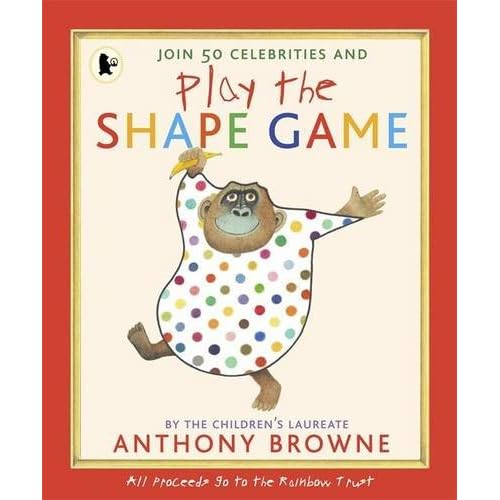
So this is what's been keeping me so busy recently that I've had little time for writing. The Shape Game project is something I've been working on as part of my work with the Children's Laureate Anthony Browne, and this new book (above) was launched on Monday.
If you haven't heard of the Shape Game before, it's basically a collaborative drawing game. Anthony Browne explains it as follows:
'The rules of the Shape Game are very simple: the first player quickly draws any abstract shape at random, the second looks at it and then transforms it into something recognisable. It could be anything – a face, a dinosaur or a fried egg. It could be a doodle or a work of art.As part of the project, 45 writers, artists, illustrators and celebrities - ranging from Quentin Blake and Shirley Hughes to Emma Thompson and Harry Hill - joined Anthony to play the game, transforming a shape he drew. You can see some of my favourites amongst the artworks below or look at a gallery on the Guardian website here. All the artworks have been published in the new Play the Shape Game book which we have been working on with the wonderful Walker Books, and which aims to help all children to be creative and use their imaginations. They're also for sale until Sunday in an online auction.
'When we were children, my brother Michael and I thought this game was our invention, but having spoken to children all over the world, I have since discovered that children everywhere know it and play their own versions. The wonderful thing about the Shape Game is that anyone with a little bit of imagination can join in.
'As Children’s Laureate, I want to help and connect with children everywhere, and encourage them to use their imaginations and be creative. Although it’s just a simple game, I believe the Shape Game is the perfect way to do this. It encapsulates the act of creativity – inspiration is everywhere. I have played the Shape Game in every single book I have made, and now you have the chance to join in and play it, too!'
Profits from the book and auction will be donated to children's charity Rainbow Trust, who provide vital emotional and practical support to families who have a child with a life-threatening or terminal illness. You can find loads more about the project on the Children's Laureate website here.
 Quentin Blake
 Shirley Hughes
Jan Pienkowski
 Sir Peter Blake
Friday, 16 July 2010
0
There's Nuffin Like a Puffin
I'm sure I'm not the only one whose childhood bookshelves (and, um, present day ones for that matter) were absolutely stuffed with books published by Puffin. One of my best ever birthday presents was a box-set of Puffin Classics which I remember reading one after the other practically without stopping to eat or sleep; and I still recall the crushing disappointment of writing off to join the Puffin Club and discovering that it had stopped running in 1983 - coincidentally the year I was born.*
It's probably no surprise, then, that my visit this week to Newcastle for the launch of a new exhibition celebrating 70 years of Puffin Books at the wonderful Seven Stories was something of a nostalgia trip. There's Nuffin Like a Puffin isn't merely an exhibition about books, but about old and wonderful friends - from The Children Who Lived in the Barn and The Borrowers through to Charlie and the Chocolate Factory, The Worst Witch and The Very Hungry Caterpillar.
I could happily have spent hours walking around, following the frieze of friendly and familiar Puffin book spines around the gallery, looking at all the fascinating material on display. Much of this comes from the Kaye Webb archive - Webb of course being the hugely influential chief editor of Puffin Books from 1961 to 1979, who was the first to publish authors and illustrators including Roald Dahl and Raymond Briggs. This archival material includes everything from editions of the Puffin Post newsletter through to annotated manuscripts, original illustrations, authors' notes and personal correspondence right down to a little card from Tove Jansson to apologise for the delay in finishing her latest Moomin book, complete with a tiny drawing of Little My.
Judging by the big, beaming grins at all the other faces at the exhibition launch, I wasn't the only one enjoying myself - and I don't think it was just the pink cakes and ginger beer served at lunch that had everyone feeling so jolly. As Kate Edwards, Chief Executive of Seven Stories, aptly pointed out: "Anyone growing up in Britain will, at some time or another, have read, enjoyed or even fallen in love with a Puffin Book." Perhaps for this reason, There's Nuffin Like a Puffin feels like an incredibly personal exhibition, engaging everyone in a different way - for me it was the original black and white illustrations from Ballet Shoes (Pauline and Petrova in their white organdie dresses) that were especially moving, whilst for others it might well be Worzel Gummidge, or Gobbolino the Witch's Cat.
However, as well as being a a wonderful and nostalgic experience for adults, this is also a hugely fun exhibition for children to enjoy - well, not even just for children really, but for all those who are up for doing things like watching sweet animations (see above), dressing up as a Puffin, crawling inside Stig of the Dump's cave, making magic spells in Meg and Mog's magical cauldron, or playing Mr Big's piano- and if you stand very, very still, you might even spot a Borrower or two!
Conclusions? Highly recommended - there truly is Nuffin Like a Puffin. What's more, if you should go to see it, there's also a lovely Lauren Child exhibition showing in the other gallery, as well as some of my favourite Brian Wildsmith in the Book Den. Hurrah for children's books! Now hand me my ginger beer...
* Fortunately the Famous Five Club was still in operation, but that, as they say, is another story...
Sunday, 18 April 2010
3
brian wildsmith: master of colour
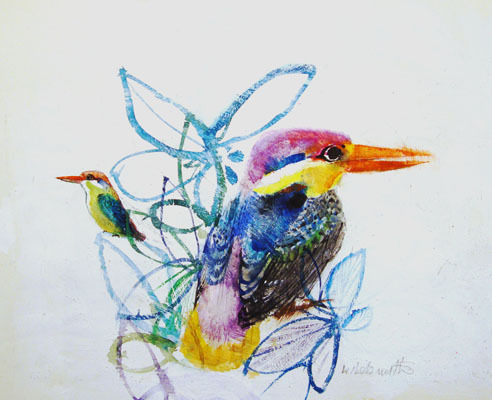
I'm interrupting my own self-imposed blog hiatus because I can't resist the opportunity to write a little something about the exhibition I saw this week - Brian Wildsmith: Master of Colour.
I've been a huge fan of Brian Wildsmith's illustrations for years, so I was excited to see that the Illustration Cupboard, a tiny (in fact, cupboard-sized) gallery, just off Piccadilly, which specialises in children's book illustrations, was hosting a special exhibition as part of the Wildsmith at 80 celebrations organised by Oxford University Press.
Interestingly, Wildsmith's work isn't hugely well-known in the UK (although he is very popular in Japan, where a whole museum is dedicated to his work) although he has certainly been an important influence on other illustrators and writers, from Children's Laureate Anthony Browne through to younger illustrators like Catherine Rayner. I especially love this quote from Michael Rosen about his childhood memories of Wildsmith's work "My childhood was full of books, but just as the Sixties burst into life, there seemed to be something similar happening in children's books. Floors of colour exploding across the pages with a name to match: Wildsmith. He was a wild smith. I remember feeling really envious: why hadn't I had books as lush and wild as these?"
"Lush and wild" sums it up perfectly, as I found when I went along to the private view on Tuesday night... Although the space was so crammed full of people that getting a really good look at any of the works was more or less impossible, this is an absolutely entrancing little exhibition, exploding with vivid colour. For me, some of Wildsmith's older works, including these animal and bird illustrations, were an especial highlight:

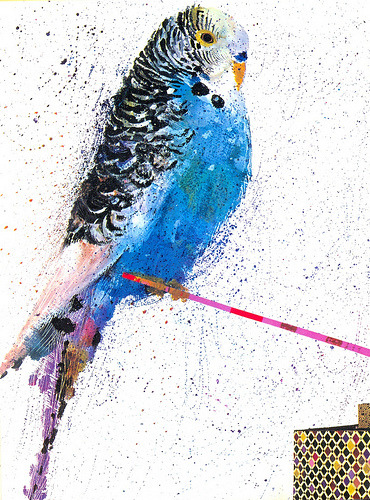


Wildsmith himself was at the private view, as well as another one of my all-time favourite illustrators, Shirley Hughes (wearing an amazing green hat) and I have to admit to spending most of the evening staring at them in what I can only describe as a stalker-ish fashion.
All of the works in the exhibition are for sale; although sadly even the prints are far out of my price range, I did treat myself to a signed copy of one of my childhood favourites, newly reissued by Oxford University Press to celebrate Wildsmith's 80th year - Animal Gallery.
There's a nice piece about Wildsmith and his work in the Independent here.
[All images by Brian Wildsmith, via Illustration Cupboard]
Saturday, 10 October 2009
7
In the Library
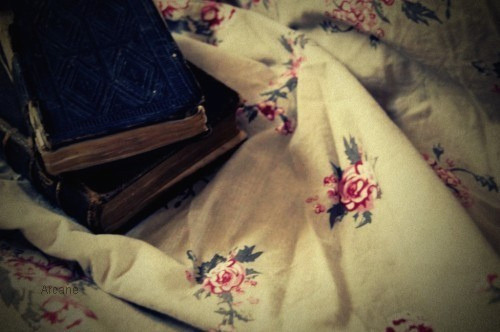
I'm spending a lot of time in libraries recently: from the amazing British Library where I'm spending most of my weekends, working on The Dreaded Dissertation, to the wonderful Barbican library, which keeps me in books to while away my daily commute.
Browsing the library shelves recently, I came upon an old favourite - an essay by the theorist Walter Benjamin entitled "Unpacking My Library". This essay is Benjamin’s hymn to his book collection, which for him becomes a “dwelling… with books as the building stones”: a home within a home into which he can disappear.
I too am a book collector. I haven't got many books here in London, but it's nice to know that back in Lancaster, they are all there waiting for me: my foundation stones, the books that built me up brick by brick. There are the vintage hardbacks with their faded paper jackets, their nostalgic endpapers, the titles arching across their spines in romantically twirled letters – Dimsie Moves Up, Dancer's Luck, Cherry Tree Perch – or dashing capitals – Underwater Adventure, Smuggler’s Cove, The Secret of Grey Walls. There are the 1970s library cast-offs with their laminated pastel covers, still shedding loose pages, tattooed with the marks of someone else’s felt-tip pen. There is that familiar rainbow of well-worn Armada paperbacks, unravelling my own past along their ragged spines: dog-eared Famous Fives and Chalet Schools interleaved with Nancy Drew adventures, priced in shillings and pence. A whole flock of Puffins: Ransome’s Swallows and Amazons jostling alongside Nesbit’s Treasure Seekers; Anne of Green Gables beside Stig of The Dump. They have a musty, archaic smell that for me will always evoke a long-lost world of bicycles and picnics and seaside adventures and plucky heroes and heroines, into which I too can disappear.
Assembled they are a cheerful, dog-eared muddle far removed from the elegant, clean-lined Parisian edifice I somehow associate with Benjamin’s book collection. This construction is infinitely more chaotic: a tiny crooked Nara-esque wendy house built out of disintegrating paperbacks, jumbled with childhood souvenirs, glinting with tarnished treasures that I can only peep at through miniature postage-stamp windows, stooping to catch distant, mysterious underwater sounds. This is my dwelling: a little house (with or without prairie), a secret garden, an enchanted wood.
Perhaps all this sounds a little too nostalgic, excessively dewy-eyed. Some years ago, I remember reading something Julie Burchill wrote in her column for The Guardian, where she derided people like me, the people who grew up secretly aspiring to “a childhood spent talking to the animals on Sunnybrook Farm perhaps, before going to board (sharing a room with Pollyanna) at Mallory Towers and then leaving with straight As to work in Narnia as Aslan’s personal assistant.” The piece was not in fact about children’s books at all, but something else entirely, yet this sentence stood out to me as if it had been highlighted, underlined in bright red pen. Burchill was doing her utmost to make the people she was describing sound ridiculous, but the more I thought about it, the more I realised this didn’t sound ridiculous at all to me. I couldn’t imagine joining Burchill in co-conspiratorial scorn at these deluded dreamers: in fact, if anything, I couldn’t help wondering how any self-respecting child raised on a diet of Blyton and C.S. Lewis could be reasonably expected to hope for anything else?
Today, “escapism” is so often dismissed with derision by writers and cultural critics: the recent tentative suggestion of children’s book author Anne Fine that maybe books don’t always need to be about realism, but instead could be the preserve of hope resulted in a barrage of criticism and condemnation. Yet from the vantage point of my paperback house, it seems to clear to me that sometimes we need to creep under the ivy, through a secret door in a garden wall, or embark on a riverside picnic with Ratty and Mole. We need to retain these happy endings, the loyal dogs and picnic baskets, the mysterious land at the back of the wardrobe. In a world where, as Thomas Wolfe once put it, “you can’t go home again,” maybe we all need a place to escape to, a “dwelling… with books as the building stones” into which we can retreat.
As for me, like Benjamin himself, I’m happiest “among… piles of volumes.” Right now, I have to admit that I really don't mind spending my Saturday morning in the British Library. In fact, I'm happy to be there, because wherever I go, I know that between bookshelves I’ll always find a home from home.
Sunday, 27 September 2009
0
Words and Pictures
I’ve always been unsure about whether it’s a good idea to write here about work-related matters. However, I just can’t resist saying a little something about the great event I was involved with organising at the Free Word Centre earlier this week.
Free Word is London’s new international centre for literature, literacy and freedom of expression. To celebrate the launch of this exciting new venue, Free Word is currently playing host to the first ever Free Word Festival, with events being organised by all the founder organisations - Apples and Snakes, Article 19, Booktrust, English PEN, Index on Censorship, The Arvon Foundation, The Literary Consultancy and The Reading Agency.
Words and Pictures was Booktrust’s contribution to the festival, bringing Children’s Laureate Anthony Browne, together with fellow award-winning illustrators Emily Gravett and Catherine Rayner to take part in a discussion about the value of picture books. These are three fantastic illustrators, with very different styles and approaches, and it was fascinating to hear them talking about their attitudes to making picture books.
Children's Laureate Anthony Browne has published over 40 books, and won numerous awards including the prestigious Hans Christian Andersen Prize. His celebrated illustrations are strongly influenced by fine art and surrealism in particular. His characters (often his trademark gorillas or chimpanzees) inhabit a finely-detailed world, where visual clues help to convey a hidden meaning or to tell a story that may be only hinted at in the text. My favourite amongst his books is undoubtedly Gorilla, which I have vivid memories of reading as a child.
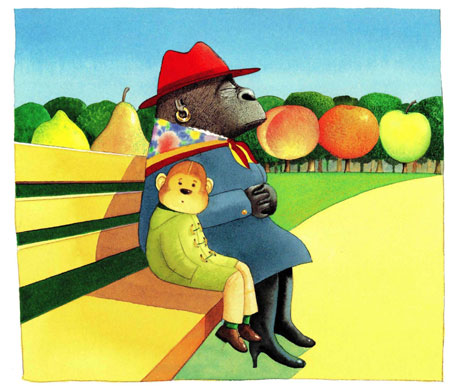 Anthony Browne, Voices in the Park, published by Random House
Emily Gravett's first book Wolves was published to much acclaim in 2005, winning several awards including the Kate Greenaway Medal. Her subsequent picture books have featured a menagerie of lovely animal characters, all drawn in her distinctive illustrative style, which often incorporates collage techniques. She is especially interested in books as objects that children can engage and interact with - I love her anarchic approach in both Wolves and also her newest book The Rabbit Problem.

Emily Gravett, Wolves, published by Macmillan
Catherine Rayner won this year's Kate Greenaway Medal with her book Harris Finds His Feet. Her beautiful, painterly illustrations of animals have won comparisons with one of my favourite ever children's book illustrators, Brian Wildsmith. I'm intrigued by the way she plays with the use of white space in her books, and experiments with design to compose each page in a unique and interesting way - and I especially love her gorgeous use of colour in Augustus and His Smile.

Catherine Rayner, Augustus and His Smile, published by Little Tiger
The thought-provoking and entertaining discussion that ensued, expertly chaired by Sunday Times journalist Nicolette Jones, covered everything from their favourite childhood picture books, to their individual stories of how they became children's book illustrators, to why they all believe picture books to be one of the most important and influential forms of art. Here's a few videos from the event:
The event finished with all three illustrators playing “the shape game” – a fun, collaborative drawing game that Anthony Browne is promoting as part of his laureateship as a way to encourage children (and adults) to draw, invent stories, and be creative.
Works by all three illustrators will be on display in the hall area of the Free Word Centre until the end of September. Find out more about the Free Word Festival and the other events coming up here.
Free Word is London’s new international centre for literature, literacy and freedom of expression. To celebrate the launch of this exciting new venue, Free Word is currently playing host to the first ever Free Word Festival, with events being organised by all the founder organisations - Apples and Snakes, Article 19, Booktrust, English PEN, Index on Censorship, The Arvon Foundation, The Literary Consultancy and The Reading Agency.
Words and Pictures was Booktrust’s contribution to the festival, bringing Children’s Laureate Anthony Browne, together with fellow award-winning illustrators Emily Gravett and Catherine Rayner to take part in a discussion about the value of picture books. These are three fantastic illustrators, with very different styles and approaches, and it was fascinating to hear them talking about their attitudes to making picture books.
Children's Laureate Anthony Browne has published over 40 books, and won numerous awards including the prestigious Hans Christian Andersen Prize. His celebrated illustrations are strongly influenced by fine art and surrealism in particular. His characters (often his trademark gorillas or chimpanzees) inhabit a finely-detailed world, where visual clues help to convey a hidden meaning or to tell a story that may be only hinted at in the text. My favourite amongst his books is undoubtedly Gorilla, which I have vivid memories of reading as a child.
Anthony Browne, Voices in the Park, published by Random HouseEmily Gravett's first book Wolves was published to much acclaim in 2005, winning several awards including the Kate Greenaway Medal. Her subsequent picture books have featured a menagerie of lovely animal characters, all drawn in her distinctive illustrative style, which often incorporates collage techniques. She is especially interested in books as objects that children can engage and interact with - I love her anarchic approach in both Wolves and also her newest book The Rabbit Problem.
Emily Gravett, Wolves, published by Macmillan
Catherine Rayner won this year's Kate Greenaway Medal with her book Harris Finds His Feet. Her beautiful, painterly illustrations of animals have won comparisons with one of my favourite ever children's book illustrators, Brian Wildsmith. I'm intrigued by the way she plays with the use of white space in her books, and experiments with design to compose each page in a unique and interesting way - and I especially love her gorgeous use of colour in Augustus and His Smile.
Catherine Rayner, Augustus and His Smile, published by Little Tiger
The thought-provoking and entertaining discussion that ensued, expertly chaired by Sunday Times journalist Nicolette Jones, covered everything from their favourite childhood picture books, to their individual stories of how they became children's book illustrators, to why they all believe picture books to be one of the most important and influential forms of art. Here's a few videos from the event:
The event finished with all three illustrators playing “the shape game” – a fun, collaborative drawing game that Anthony Browne is promoting as part of his laureateship as a way to encourage children (and adults) to draw, invent stories, and be creative.
Works by all three illustrators will be on display in the hall area of the Free Word Centre until the end of September. Find out more about the Free Word Festival and the other events coming up here.
Tuesday, 1 September 2009
0
weekend in edinburgh
I’ve just got back from a brief but action packed trip to Edinburgh for the Book Festival. Some quick highlights: watching wide-eyed children play drawing games with Children's Laureate Anthony Browne; eating local Scottish scallops; spotting a little old lady dancing all by herself to funky street music; beautiful views over the city from the top floor of the Chamber Street museum; people-watching, coffee-drinking and bookshop-browsing at the festival site at Charlotte Square Gardens; checking out Greenaway prize-winner Catherine Rayner’s beautiful illustrations (including a giant moose!); Eva Hesse’s delicate cheesecloth and papier mache studio works at The Fruitmarket Gallery; and spotting a super-cool China Mieville hanging out at the Author’s Yurt.
However I have to admit that my favourite moment of the whole weekend was probably watching three Grey seals catching up on a little peaceful sunbathing in Dunbar harbour on Sunday morning.
Now back to London again…
However I have to admit that my favourite moment of the whole weekend was probably watching three Grey seals catching up on a little peaceful sunbathing in Dunbar harbour on Sunday morning.
Now back to London again…
Thursday, 30 April 2009
1
forgotten children's favourites
 To mark the 10th anniversary of the children’s laureateship, the current holder of the post, Michael Rosen, and his four predecessors - Michael Morpurgo, Jacqueline Wilson, Quentin Blake and Anne Fine - this week selected their favourite children’s books. They were allowed seven choices each (you can read their lists here) and each chose some of my own favourite children's reads, ranging from The Box of Delights (Quentin Blake) to The Wolves of Willoughby Chase (Anne Fine) to The Railway Children (Jacqueline Wilson). I was particularly pleased to see that Michael Morpurgo even opted for a deeply unfashionable Blyton amongst his selection - the particularly fine Five Go to Smuggler’s Top.
However, what I did notice about the laureates’ choices is that with a few notable exceptions, they mainly opted for the “classics” of children’s literature: well-known books that are already established as general favourites. To continue my recent “children’s books” theme, I thought it might be interesting to create my own list of favourites with a difference - a list of “forgotten” children’s books rapidly disappearing into the lands of obscurity, that are maybe not quite so universally well-known. Here are my seven "forgotten favourites:"
1. Mystery at Witchend by Malcolm Saville
Written in the 1940s, this is a good old fashioned adventure in which a group of children (plus loyal dog) thwart a wartime sabotage plot by dastardly German spies. It’s the first in the Lone Pine series, a more sophisticated take on the Famous Five in which the members of the Lone Pine Club, armed with little more than their bicycles, sandwiches and hand-drawn maps, solve mysteries taking in everything from counterfeiting to sheep-rustling in a variety of real locations. Writing into the 1970s, Saville attempted to “sex up” the later books adding criminals with (shock!) guns, and even a touch of romance for his teenage characters who by now had traded in their cotton frocks and shorts for jeans, but the books still manage to retain their carefree innocent feel.
2. The Swish of the Curtain by Pamela Brown
First published in 1941,The Swish of the Curtain is a sort of original Fame! - the story of a group of children who, bored during a long summer holiday, discover an abandoned chapel in their home town and decide to transform it into a theatre. As the Blue Door Theatre company, they quickly develop serious theatrical ambitions, in spite of the opposition of their parents. Written by Brown when she herself was just fourteen, the novel is peculiarly timeless: in spite of the archaic picture it presents of a genteel suburbia complete with a kindly Bishop (the children’s ally) and a cringe-inducing Women’s Institute headed up by the dreaded Mrs Potter-Smith (their arch-nemesis) it feels very contemporary in tone, perhaps simply because of its robust sense of humour.
3. Greenwitch by Susan Cooper
In spite of the recent movie version, Susan Cooper’s Arthurian-inspired fantasy series, the Dark is Rising sequence seems to be distinctly out of fashion at the moment, perhaps because of its slightly 1970s homespun Woodcraft Folk-ish feel. The best known of the series is the second - the brilliant, and extremely scary The Dark is Rising - but my personal favourite is the third book, which focuses more on Cooper’s main female character, Jane. Set in Cornwall, it’s a classic seaside children’s adventure story but given a darker fantasy twist, haunted by the powerful mythical figure of the Greenwitch herself. The final section inevitably leads to what Nancy Mitford refers to as “Brimming”.
4. We Didn’t Mean to Go to Sea by Arthur Ransome
Surprisingly, Ransome’s famous Swallows and Amazons didn’t make it into any of the laureate’s selections, even though it’s an undoubted children’s classic. For my money though, We Didn’t Mean to Go to Sea is even better: the story of what happens when the Walker children’s holiday plans go wrong, and they find themselves unexpectedly fighting a storm in the treacherous waters of the North Sea, drifting away from the safety of the English coast into the shipping lanes - and into a real adventure. Marking a definite change of pace from the rather annoying whimsy of Peter Duck or the slightly too try-hard comedy “hi-jinks” of The Picts and the Martyrs, this a compelling heart-in-your-mouth story of adventure on the high seas.
5. Fifteen by Beverley Cleary
Beverley Cleary is now best known as the creator of naughty Ramona and her long-suffering older sister Beezus, but she also wrote Fifteen, a 1950s take on the “young adult novel.” It evokes an innocent, All-American world of high school dating, which already seems distinctly archaic: a lost realm of milkshakes, pin-curls and good manners. Gossip Girl it certainly isn’t, yet naive small-town heroine Jane faces all the familiar dilemmas of adolescence (how to decide what to wear to the dance; how to work out if Stan really likes her; how to deal with sophisticated, cashmere sweater- wearing Marcy), even managing to take in the unfamiliar exoticism of yes, a Chinese restaurant with characteristically gutsy good humour.
6. Clover by Susan Coolidge
I have to make a confession now: I still find all those old-fashioned “girls' books” - Little Women, Anne of Green Gables and the like - weirdly compelling reading. However my real favourites are the little-known “wild cards” of this genre: L.M. Montgomery’s Emily books, Louisa M. Alcott’s hilariously moralistic An Old Fashioned Girl, and especially one of the lesser-known sequels to What Katy Did, Susan Coolidge’s Clover. Leaving behind rather tiresome Katy (who, let’s be honest, since that whole thing with the swing has really become a bit of an annoying goody-two-shoes) this story focuses on younger sister Clover as she embarks on some much more exciting adventures Out West.
7. The Circus is Coming by Noel Streatfeild
Noel Streatfeild is perhaps most famous for the children’s classic Ballet Shoes, which won a place on Jacqueline Wilson’s shortlist. However, she also wrote many other novels, many of which are based around the theatre. The Circus is Coming marks a bit of a departure from the theme, being set in the world of (you guessed it) the circus. A bit less overtly girly than many of Streatfeild’s books, it tells of the adventures of prim and proper brother and sister Peter and Santa, who unexpectedly find themselves living with their estranged Uncle Gus, a circus acrobat, and become increasingly drawn into the world of the circus itself. (For any other serious Streatfeild fans out there, can I also alert you to her little-known autobiographial novel A Vicarage Family? Read it with a box of tissues close by, however. You too will be “Brimming”: I guarantee it.)
Friday, 24 April 2009
3
the arrival
 I was recently given a copy of The Arrival by Shaun Tan. I've never come across Tan's work before, but after reading this thoughtful, beautifully-illustrated book - which is poised somewhere between a graphic novel and a children's picture book - I'm an instant fan.
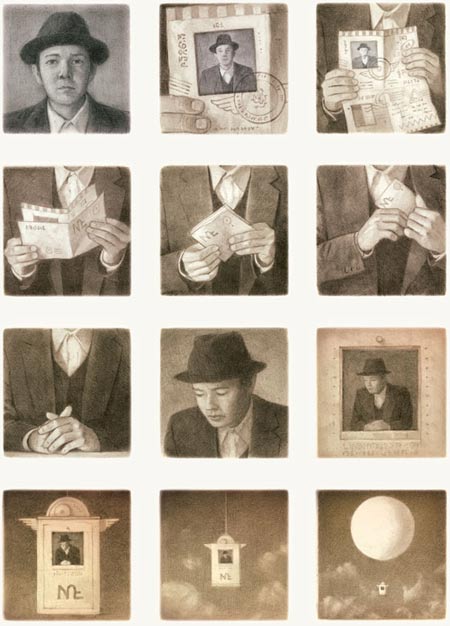 The Arrival is a universal story of migration and displacement, told through a series of wordless images. A man leaves his wife and child behind in an impoverished town, seeking better prospects in an unknown country of unknown customs and behaviours, mysterious objects, peculiar animals and indecipherable languages. Luckily many of the strangers he meets in this new metropolis have shared his experience, and transcending barriers of language and difference, are keen to help him on his way.
Tan's exquisitely detailed illustrations in sepia tones evoke old family photographs and histories, creating a powerful nostalgic quality: this could easily be a story from some forgotten lost time gone before. However this hopeful, wistful tale is also peculiarly contemporary on its take on the universality of migrant experience, and the importance of communities and belonging. As Tan himself suggests in this interesting commentary on how the book came to be written, 'we might do well to think of ourselves as possible strangers in our own strange land.'

Thursday, 16 April 2009
9
a somewhat polemical princess
 I was surprised to discover this week, via the Guardian Books Blog, that Hodder plan to publish a sequel Frances Hodgson Burnett’s 1905 children’s classic A Little Princess, this September.
 A Little Princess is one of my all-time favourite children’s books, with a fabulous riches-to-rags-and-back-to-riches narrative arc. Sara Crewe, “the odd little girl with the big solemn eyes” is the wealthy but unspoilt heroine with a lively imagination, who travels from her home in India to London to attend Miss Minchin’s Select Seminary for Young Ladies where her good manners and intelligence lead her to quickly become the “show pupil”. But when her beloved father’s sudden death leaves Sara unexpectedly penniless, the unpleasant Miss Minchin (surely one of the best ever children’s book baddies) forces her into drudgery, revealing a much nastier side of Victorian London life. However, with the help of a little courage and fortitude - not to mention a few loyal friends - just when things are at their very worst, magical things begin to happen. A Little Princess has a fantastic ending, and regardless of whether you’ve warmed to Sara, or found the whole thing a bit on the twee side, it is impossible to read it without melting into a happy, warm and sentimental Victorian mush.
The planned sequel will be entitled Wishing for Tomorrow (which I am afraid really is twee) and has been written by Hilary McKay, the author of a number of bestselling children’s books including Saffy’s Angel. The new story will not follow Sara herself, but some of the other characters we meet at Miss Minchin’s establishment, in particular Sara’s friend Ermengarde - the “monumental dunce of the school”, “a fat child who did not look as if she were in the least clever.”
Now I have to admit, A Little Princess is certainly a book that leaves the reader wanting more - but the prospect of Wishing Tomorrow fills me with dread. Partly that's because of McKay's decision to reject the style of the original, which she felt would not appeal to contemporary readers, to “make the children more childish” and to include “a few more jokes.” All of this seems to me to be based on a total misunderstanding of what makes the original book so charming and distinctive: after all, Sara is a brilliant heroine precisely because she isn't childish or cutesy, but solemn, thoughtful and a little bit quirky - a young person to be reckoned with. And A Little Princess is far from being without humour, but it is a humour which is always subtle and rather arch - I can't imagine why anyone would think chucking in a few "jokes" to liven things up would be a fitting tribute. Mostly, I think I just generally resent the notion that the book's style needs "improving" for today's audience - as if it isn't bad enough that we're already subjected to dire re-visionings of beloved childhood books in the form of Hollywood movies (see Northern Lights; The Secret of Moonacre; and also the grim new film of Susan Cooper’s The Dark is Rising, featuring Ian McShane - yes, that’s Lovejoy - as Merriman Lyon) we now find writers, who might be expected to know better, imaginatively "polishing up" our favourite childhood fictions into glossy, bland 21st century shadows of their former selves.
What is more, much as I love A Little Princess, I can't help feeling that there's something a little bit disappointing about the very notion that writing a sequel to a book published over 100 years ago is the best one of our leading children's writers can come up with. I can absolutely see the appeal of the project, but wouldn't it be better if we could see contemporary children's writers creating fictional worlds as exciting, compelling and delightful as Burnett's, but for our own times? Alternatively, rather than just continuing the story, wouldn't it be more interesting to do something a little more challenging and different with A Little Princess as source material - perhaps as Eva Ibbotson does in the excellent Journey to the River Sea which is undoubtedly in part a tribute to Burnett.
However, ultimately the fundamental problem I have with Wishing for Tomorrow is simply this: I am really not a fan of sequels. On the whole, they are just a Bad Idea. As I am sure anyone who has read Emma Tennant’s Pemberley (or any of the other dire Pride & Prejudice sequels - though strangely, the new “zombie” version looks quite appealing) will attest, there are times when (unless you are Jean Rhys) it’s best to leave well alone. Admittedly, Susan Hill’s Mrs de Winter, which follows on from Rebecca was slightly less painful, but I’d much rather have just left the story where it was - with a question mark. More often than not, a little bit of mystery is so much more appealing than tidy resolution.
I'm aware all this is not particularly fair or objective: after all, the poor woman hasn't even published her book yet, and I've already decided it isn't worth reading. For all I know, it might be brilliant. But right now, I have to say that I definitely won't be rushing down the shops to get my hands on McKay’s Little Princess continuation when it comes out in September. Instead I might just happily re-read my old Puffin copy of Frances Hodgson Burnett’s original, complete with evocative and nostalgic illustrations by Margery Gill:
Once on a dark winter's day, when the yellow fog hung so thick and heavy in the streets of London that the lamps were lighted and the shop windows blazed with gas as they do at night, an odd-looking little girl sat in a cab with her father ...
Saturday, 2 August 2008
1
quote for today
"Is that you, Rabbit?" said Pooh.
"Let's pretend it isn't," said Rabbit, "and let's see what happens."
-- A. A.Milne
Seven Stories is absolutely brilliant, by the way. Everyone should go there immediately. You can dress up as Ratty or sit in Mr Toad's car, except when I went there the horn had broken because too many children had been pooping it. Great stuff.
"Let's pretend it isn't," said Rabbit, "and let's see what happens."
-- A. A.Milne
Seven Stories is absolutely brilliant, by the way. Everyone should go there immediately. You can dress up as Ratty or sit in Mr Toad's car, except when I went there the horn had broken because too many children had been pooping it. Great stuff.








 Posts
Posts


