Showing posts with label whitechapel. Show all posts

London Art Book Fair 2010

Last weekend I headed to The Whitechapel Art Gallery for two of my favourite things in one – art and books together at the London Art Book Fair.

This annual event devoted to international art publishing showcases books by everyone from the big players (Tate, Thames & Hudson, Phaidon and co.) through to quirky independent zines, gallery publications, self-publishing projects and beautiful one-off books created by artists. This year’s fair was also accompanied by a whole host of book related activities, ranging from book signings with artists like Martin Creed and Bob & Roberta Smith, to workshops on creative writing and artist books, to talks on subjects like self-publishing and e-zines.

As someone who is endlessly fascinated by all books, but in particular by the idiosyncracy, individuality, tactile loveliness and sheer good fun of DIY publishing, I have to admit that for me, going to the London Art Book Fair is a bit like going to a sweet shop. Here are a few favourites that caught my eye:

The Whitechapel has its own range of publications, including exhibition catalogues and artist publications like The Jake and Dinos Chapman Colouring Book. However, I’m a particular fan of their Documents of Contemporary Art Series, which bring together a rigorous selection of writings and theoretical texts on a particular topic – be it Participation, The Archive or The Artist’s Joke. Although they ostensibly have a focus on contemporary art theory, there are texts by all kinds of theorists and cultural commentators here, and titles like The Gothic and The Sublime are definitely relevant to a wider audience.


Art of McSweeney
’s was the title that instantly grabbed my attention at the Tate Publishing stand. With a dust-jacket that folds out into a double-sided poster, copious illustrations and contributions from collaborators including Michael Chabon, Daniel Clowes, Robert Crumb, Marcel Dzama, Joyce Carol Oates and Chris Ware, this is a rich and beautifully presented book in the true McSweeney’s tradition. You can watch a short video about the book here:


Tate also publish an interesting selection of illustrated children's books, which true to form, I find it difficult to resist. I love Around the World With Mouk, which follows the international adventures of a cute globe-trotting bear, and one of my most recent acquisitions is Counting Birds, a charmingly illustrated picture book by Alice Melvin, with lovely spreads like this:


Amongst their children's titles at the book fair, I also took a fancy to their new Art Collector game – a variation on the traditional Happy Families-style card game, where children can aquire, collect and trade famous works of art from Warhol to Whistler. Perfect practice for the Charles Saatchis of the future. And I was immediately drawn to Big-Top Benn by David McKee: first published forty years ago, this is the original story of Mr Benn, who here swaps his bowler hat for a clown costume and is transported into the colourful world of the circus. More lovely, evocative spreads to enjoy:


Black Dog Publishing are a relative newcomer on the publishing scene, but have already published an impressive range of intriguing illustrated books about art, architecture and contemporary culture. I have to admit to being a little disappointed by their recent book Illustrated Children’s Books (though I admit when it comes to children’s books I am probably hard to please) but I enjoyed a good flick through a new title, Alphabets: A Miscellany of Letters by David Sacks.

Four Corners Familiars
is a series of titles from Four Corners Books that particularly appeals to me. Artists are invented to respond to classic novels and short stories, resulting in some very different kinds of reading experiences. The Picture of Dorian Grey with art by Gareth Jones reimagines the story as a costume drama set in 1970s Paris in a large-format edition that returns to the story’s original origins in a magazine; whilst James Pyman presents Dracula in a series of different typefaces based on those used at the time of the novel’s publication; and Donald Urqhart gives Becky Sharp a 1930s Hollywood feel in Vanity Fair.


Amongst the individual artists and designers whose work was on display, I loved graphic designer and illustrator Kaho Kojima’s quirky printed books and pop-ups. Chisato Tambayashi also uses pop-ups and paper cutting techniques in a series of beautiful books and cards like these:
One of my favourite new discoveries at the fair was Lovely Daze, a curatorial journal that is published biannually. The journal aspires to provide a platform for artists to present their writings and artworks, and each one has a different topic or theme, ranging from ‘a day in New York when nothing happens’ through to ‘Numbers’. My favourite, however, was a special edition recipe book by pastry chef Angela Garcia, accompanied by incredibly beautiful paintings by Cristina Roduriguez, on the theme of ‘A rose is a rose is a rose is a rose’. What could be better than yummy paintings and recipes?


Finally, for anyone at all interested in reading more about art books, zines and artist publications, I heartily recommend the wonderful blog Book By Its Cover - a treasure trove of lovely books to discover and explore.

[All images from publisher websites unless otherwise specified]

alice neel: painted truths

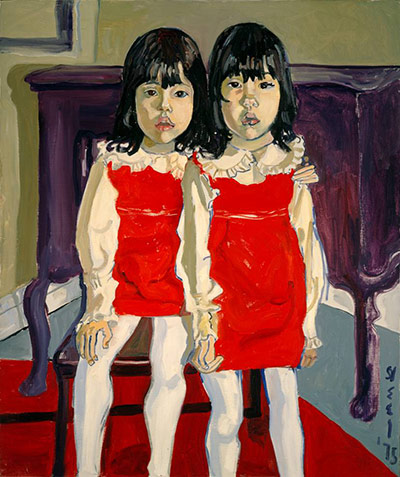
The De Vegh Twins, 1975

Alice Neel: Painted Truths, currently showing at the Whitechapel Art Gallery is a challenging exhibition to put into words: Adrian Searle, writing in the Guardian sums it up well as 'exhilarating, touching and a bit wild' but thinking over this powerful body of work, the word that returns to me more than any other is 'unflinching'.

Credited with challenging the conventions of portraiture, Alice Neel is perhaps best known for painting many of the artists, poets and radicals of her day - portraits of Andy Warhol and Frank O'Hara are amongst those in this retrospective. However, as this exhibition makes clear, her art also depicts a range of subjects usually excluded from mainstream portraiture - the elderly, pregnant women, families from Harlem's immigrant communities, a Fuller Brush salesman, a child clutching a cat.

These works are often highly exaggerated, sometimes even grotesque: Neel's subjects are represented in bold brush strokes and florid colours, with spindly long-fingered hands, fixing the viewer with wide, troubling eyes. Yet in spite of this almost cartoon-like exaggeration and distortion, there is a profound honesty in Neel's work. Her subjects are depicted in all their wonky awkwardness: scarred, saggy, abject, uneasy. Often highly unflattering, these are also tender, touching paintings that expose the vulnerabilities and anxieties of her subjects - portraits made powerful by their psychological, if not representational truth.

This sensitively-curated exhibition focuses predominantly upon portraiture structuring Neel's work with a series of themes including Portraits and Memory, Nudes and the Detached Gaze; yet some of my favourite works here are in fact cityscapes: portraits of Neel's New York. These range from jaunty images of New York street architecture executed with an unusual lightness of touch, through to darker and more troubled works which hint at the aftermath of the Depression, but also Neel's own sense of herself as a woman restricted and confined within a domestic environment. Neel's involvement with New York and its artistic and radical communities becomes a thread that runs through this exhibition, which also references the events of her life, from early tragedies (in her early twenties she lost one daughter to diphtheria and another in a custody battle with her first husband), and subsequent breakdowns, to poverty, failing relationships, but ultimately, towards the end of her life, her rising fortunes as an artist.

9th Avenue, 1935

Although Neel is often represented as something of an iconoclast, what interested me about many of these works was their references to the tradition of painting, evoking everyone from Van Gogh to Cezanne to Edward Hopper. Night, one of my favourite paintings in the exhibition, and certainly amongst the most understated, recalls the abstract expressionist Clyfford Still; whilst Dead Father seems reminiscent of the work of Marc Chagall. Yet regardless of style, what unites this formidable and varied body of work is its honesty. It is the sheer frankness, the unflinching directness of Neel's 'painted truths' that makes them so exhilarating - and ultimately gives them their power.

Alice Neel: Painted Truths is at the Whitechapel until 17 September.

sophie calle: talking to strangers

I love this beautiful photograph from Talking To Strangers, a retrospective exhibition of work by the French artist Sophie Calle, which I recently went to check out at the Whitechapel Art Gallery.

The exhibition includes the premiere of the English language version of Prenez Soin de Vous (Take Care of Yourself), which was first shown as part of the 2007 Venice Biennale, and which I've been looking forward to seeing ever since I first heard about it. This installation is a response to an email Calle was sent by her lover, the unnamed ‘X’, ending their relationship, which concludes with the words ‘take care of yourself’. Calle invited women, ranging from a ballerina to an accountant, a tarot card reader to a sharp-shooter, to use their professional skills to interpret the text, as follows:

“I asked 107 women... chosen or their profession or skills, to interpret this letter. To analyse it, comment on it, dance it, sing it. Exhaust it. Understand it for me. Answer for me. It was a way of taking the time to break up. A way of taking care of myself.”

Walking through this beautifully presented installation, a combination of video, photography and text, we encounter the responses of everyone from a 9 year-old girl (‘It is sad’) to a criminologist (he says ‘I’ more than 30 times in a letter with 23 sentences’). Actors Jeanne Moreau and Miranda Richardson read the text aloud in French and English respectively; others interpret it through dance, music, puppetry and even chess; a children’s writer transforms it into a fairy tale; whilst my personal favourite, Brenda the green parrot, happily tears it to shreds in her beak. Prenez Soin de Vous is a deeply intriguing and often very entertaining work: I could happily have stood for hours exploring this fascinating multiplicity of responses. However there’s also something slightly unnerving about this cacophony of female voices, perhaps partly because it is so powerfully gendered. Whilst it can be read as a straightforward celebratory feminist artwork, the installation also hints to both aggression and obsession directed towards the invisible (and perhaps indeed fictional) excluded male subject, the unknown ‘X’. Yet there is the distinct sense here that the artist herself is aware of these tensions, subtly and playfully exploiting the sense of ambiguity in her work: we are left feeling that it would probably be possible to construct just as many different ‘readings’ of Calle’s artwork as there are responses to ‘X’s original text itself.

The exhibition continues upstairs with earlier works spanning the past 20 years of Calle’s career, many of which demonstrate a similar kind of subtle ambiguity. In The Sleepers (1979) the artist made one of her earliest forays into participatory and collaborative work, inviting 29 strangers to sleep in her bed; this interest is continued and developed through works like The Address Book (1983), a voyeuristic investigation of the owner of a found address book through the contacts listed within it, and Berck (2008) in which Calle invites a medium to determine her actions on the basis of clairvoyant predictions. Amongst these earlier pieces, I particularly enjoyed Gotham Handbook (1994), in which Calle follows to the letter a series of instructions sent to her by the writer Paul Auster - including talking to and smiling at strangers; handing out cheese sandwiches and cigarettes to homeless people; and adopting a corner of the city, in this case a phone box which she ornaments with flowers, snacks, magazines and ‘have a nice day’ notices - and minutely records the social interactions that result.

For me, Calle’s work seems distinctively French – elegant, disarmingly confident in its treatment of complex ideas, and exhibiting a sprinkle of charming, almost Amélie-like whimsy. But what I find particularly interesting and engaging about these works are their explicitly textual nature: this is art about language and interpretation, art that tells stories, art that requires reading – it’s no surprise to learn that Calle has collaborated with a writer like Auster, even appearing as a fictional character in one of his novels.

Altogether, Talking to Strangers was a fascinating experience: at once deeply personal, whilst simultaneously exhibiting a certain arch detachment. Indeed, intelligent and nuanced though they may be, what I finally liked most about these works is their playful sense of humour; even Prenez Soin de Vous itself comes with a knowing wink and a smile.


[Images via Whitechapel Gallery]